
Indonesia’s G20 Tightrope: Embracing 2026 US Chairmanship of the G20
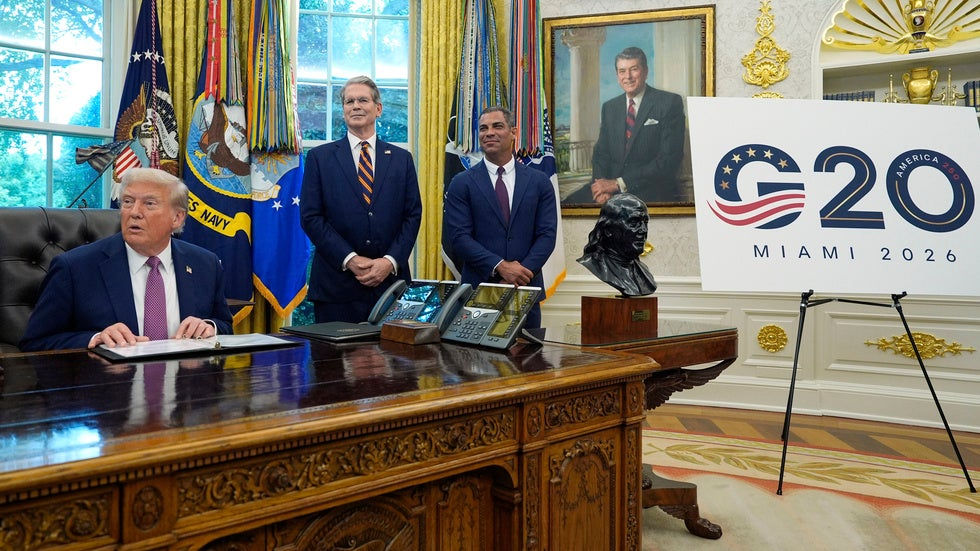
Recent U.S. actions, such as intervention in Venezuela, measures targeting Iran, and withdrawal from dozens of multilateral institutions, have drawn global attention and led many countries to anticipate broader shifts in U.S. foreign policy, including how Washington may exercise leadership during its 2026 G20 Chairmanship. After the anti-climax closure of the South African Chairmanship of the G20 last November, multilateral economic diplomacy will see a new dawn in the chairmanship of the U.S. in the G20. The U.S played a historical role by chairing and hosting the first-ever G20 Leaders’ Summit in Washington, D.C., in 2008 in response to the global financial crisis. But for this current chairmanship, many were wondering if the U.S. would exhibit the rigour and vigour needed to rekindle the grouping after its recalcitrant behaviour towards the South African Chairmanship.
The dramatic refusal to send high-ranking American officials, even as the U.S. prepares to take over the G20, has infallibly sent distressing signals. G20 members will be justified if they reconsider and recalibrate their engagement strategy and perception of achievements in the coming G20 meetings and summits.
Against such a backdrop, Indonesia must also play its cards well into 2026. There will be challenges in G20 under the U.S. Chairmanship, but there will surely be opportunities for Indonesia to reap while contributing to the G20 multilateral economic agenda-setting throughout 2026. This could begin by envisioning the Chairmanship trajectories of the U.S.
Two Trajectories for the U.S. G20 Chairmanship
The U.S. economic posture under the Trump administration has been defined by unilateral trade actions. It is strongly reinforcing the perception that global stability is constantly vulnerable to shifts in American domestic politics. Looking ahead, two trajectories for the U.S. G20 Chairmanship emerged.
The first path is a “business-as-usual scenario”, one fully consistent with “America First”. Under this model, Washington will utilize the G20 primarily as a forum to advance its domestic priorities, viewing any multilateral commitment through the narrow lens of national political and economic gain. In this scenario, any commitments within G20 will be assessed through U.S. political and economic calculations, and with a focus on more transactional forms of cooperation.
It is also likely that under U.S. leadership, the G20 will adopt a less ambitious climate agenda. Trump’s UN speech last September, where he called climate change the “greatest con job ever”, underscores how low environmental issues rank on his agenda. Given this stance, any green initiatives under the U.S. leadership in the G20 are likely to be just a pro-forma exercise, which is a setback for a forum that has included environmental commitments in its leaders’ declaration.
The second path is an “out-of-the-box scenario”, where the U.S. uses its G20 Chairmanship not to disengage from global leadership, but to actively reshape it. Trump may push for new initiatives that institutionalize American economic and strategic advantages, particularly in critical minerals, supply chain security, and dollar-based financial systems.
U.S. priorities are already reflected in its proactive efforts throughout 2025 to secure critical mineral agreements with key partners, including G20 members like Australia, Japan, and Saudi Arabia. With critical minerals already central to G20 conversations, Washington has room to push for a more institutionalized global framework, one that strengthens the U.S. leadership and binds other members into norms that favor American advantages in high-tech, energy, and defense.
For Indonesia, both paths present significant risks but also unprecedented opportunities. While U.S. policy shifts could introduce new pressures on trade and financial stability, Indonesia’s role in critical mineral supply chains and sustainable development gives it valuable leverage.
Indonesia’s Strategic Response
Under a business-as-usual scenario, Indonesia may struggle to elevate issues such as climate resilience, sustainable development, and energy transition. Meanwhile, an out-of-the-box scenario, one centered on critical minerals and supply chain restructuring, could present its own challenges, particularly if U.S frameworks diverge from Indonesia’s priorities. Either way, Indonesia cannot be passive. It needs a coherent agenda aligned with President Prabowo’s priorities on food security, energy security, and industrial upgrading.
Indonesia’s strategic assets give it room to lead. With President Trump likely to prioritize a global critical minerals agenda, Indonesia can position itself not just as a supplier but as an agenda-setter. As one of the world’s largest producers of nickel, Indonesia can engage the U.S. across the entire minerals value chain to advocate for technology transfer, attract investment in higher-value processing facilities, and promote environmentally responsible production standards that support long-term competitiveness.
This moment also allows Indonesia to shape broader G20 discussions in ways that reflect its development path. Indonesia can elevate food and energy security, issues that resonate across advanced and developing economies, to help reduce ideological tensions within the G20 and reinforce Indonesia’s domestic objectives, from strengthening maritime energy corridors to securing supply chains. On climate issues, reframing climate action as a matter of economic resilience and cost efficiency will appeal more to the Trump-led G20 than traditional climate diplomacy.
A Trump-led G20 will test global cooperation. For Indonesia, the goal is not only to maintain a presence at the table but to shape outcomes during a period of heightened uncertainty. By combining strategic caution with active leadership, Indonesia can convert its mix of vulnerability and indispensability into lasting advantage. If Jakarta navigates this moment effectively, the 2026 G20 Chairmanship under U.S. leadership could become an opportunity to strengthen economic resilience, expand industrial capabilities, and guide global cooperation toward a more pragmatic and development-oriented direction.
This article is written by Karlina Aucia Agusta, Principal for Policy and Program at the Indonesian Business Council (IBC) and a graduate of Carnegie Mellon University, and Lusia Novita Sari, Policy Analyst at the Ministry of State Secretariat of the Republic of Indonesia and a graduate of New York University. The views expressed are their own.


Comments