
Navigating ASEAN Centrality in the Shadow of Philippine Geopolitical Dualism
Updated: Nov 20, 2025
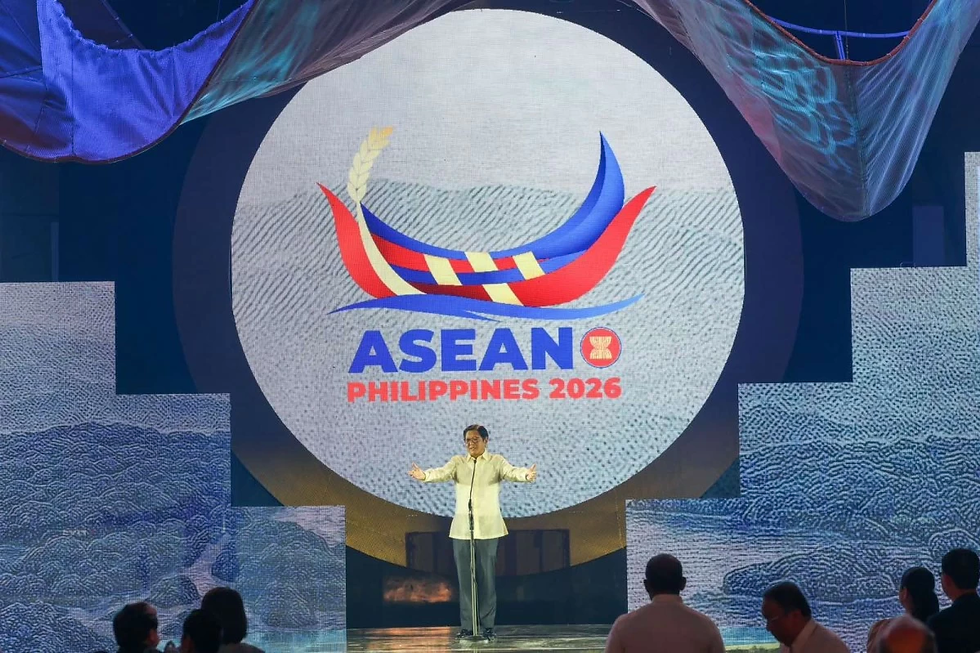
When the Philippines assumes the Chair of the Association of Southeast Asian Nations (ASEAN) in 2026, it will do so at a pivotal and precarious moment for the region. The Chairmanship, themed “Navigating our Future, Together,” comes not only amid deepening geopolitical tensions in the South China Sea. It also immediately follows a dramatic shift in Manila’s foreign policy orientation. After the preceding administration’s controversial pivot toward Beijing, Philippine President Ferdinand Marcos Jr. has decisively re-anchored the country to its traditional security ally, the United States of America (USA), and adopted an increasingly assertive, rules-based stance against China’s “encroachment” into its maritime zones, which, according to Manila, violates its sovereignty. This strategic divergence marks a period of profound geopolitical dualism, where the Philippines’ security alignments (pro-USA) stand in tension with its economic interests (sustaining ties with China) and its required role as a neutral, consensus-driven ASEAN Chair.
Philippine diplomacy and the enduring principle of ASEAN Centrality itself. The core challenge for Manila will be how to leverage its year-long leadership to advance its own national security interests, particularly in the South China Sea, without sacrificing its credibility as the neutral steward of a Bloc that seeks to avoid being forced to choose between great powers.
The Philippine foreign policy shift under the Marcos Jr. administration has been characterized by a robust revival of the US-Philippines alliance, which is viewed by some analysts as an attempt to practice “peace through deterrence.” This has been visibly manifested through the expansion of the Enhanced Defense Cooperation Agreement (EDCA), increased military interoperability, and the strengthening of a network of minilateral security partnerships with allies like Japan and Australia (The Squad). The renewed focus on its treaty alliance is a pragmatic response to escalating “grey zone” tactics by China in the West Philippine Sea (the Philippine portion of the South China Sea), where maritime confrontations have become regular occurrences.
The country’s assertive pushback against China’s maritime claims, while upholding a 2016 international arbitral ruling, makes it one of the most vocal opponents of Beijing within the regional body. This stance, while crucial for Philippine sovereignty, creates a difficult diplomatic situation: the Chair is expected to be a consensus builder, not to push its own interests too aggressively, which can be seen as “self-serving” and risks setting a dangerous precedent. So, the primary challenge of the 2026 Chairmanship is managing the dichotomy between the Philippines’ assertive national interests and ASEAN’s collective imperative for neutrality and unity.
ASEAN Centrality—the idea that the regional body should be the primary driving force for political, security, and economic cooperation in the Indo-Pacific—is significantly tested when one of its Members is seen as closely aligned with one of the great-power rivals. The Philippines’ expanded network of security partnerships (often termed external balancing) is seen in Manila as a necessary measure for generating security outcomes that ASEAN’s slow, consensus-based mechanisms often fail to deliver. Hitherto, this very approach risks eroding the Bloc’s cohesion and drawing it deeper into the US-China rivalry, a scenario most Member States wish to avoid.
During its tenure, Manila will need to convince its regional peers that its robust defense alliances are a demonstration of commitment to a rules-based order that benefits all of ASEAN, rather than simply a mechanism for advancing a Philippine-US agenda. The success of the Chairmanship will therefore depend on the delicate balancing act by President Marcos Jr., requiring him to champion collective regional interests while simultaneously upholding the principles of international law that are paramount to the country’s territorial defense.
Despite the geopolitical tensions, the Philippines has laid out a comprehensive agenda for its 2026 term under the three pillars of peace and security, prosperity, and people empowerment. The most closely watched priority is the pursuit of a Code of Conduct (COC) for the South China Sea. Manila has openly expressed hope for the finalization of a binding COC in 2026. The Philippines, a claimant State, has a unique opportunity to leverage its leadership to push for a document that is “consistent with international law, particularly the 1982 United Nations Convention on the Law of the Sea (UNCLOS).” Albeit, several analysts are skeptical, noting that negotiations have dragged on for decades, and any final pact agreed upon with China may lack the necessary enforcement teeth, potentially disappointing Manila’s legal-normative ambitions. Manila must push for progress on the COC as a collective ASEAN agenda item, avoiding the perception that it is using the Chair solely to advance its own dispute with China.
Beyond the maritime dispute, the Philippines will champion regional cooperation on new security challenges, vis-à-vis placing a significant emphasis on the responsible and ethical use of Artificial Intelligence (AI) for applications like maritime domain awareness, early warning systems, and humanitarian assistance and disaster response (HADR). Worth to recognize is that the agenda also includes deepening economic integration and trade facilitation and continuing efforts on internal conflicts, such as appointing a Special Envoy to navigate the political impasse in Myanmar.
At the same time, the Philippines, in terms of national economic interests, remains economically intertwined with China, participating in Belt and Road Initiative (BRI) projects and relying on Chinese trade and investment. The business elite and some political factions in the country continue to push for pragmatic engagement with Beijing, often citing the dangers of economic decoupling and the impossibility of full confrontation, with Marcos Jr.’s hardline policy, albeit Marcos Jr. still view China as a dependable economic partner. “Stronger ties mean better trade, greater investments, and enhanced collaboration.” Marcos Jr. said.
This economic interdependence may serve as a stabilizing factor that moderates conflict escalation, offering ASEAN a potential buffer against regional polarization. On the other hand, it also introduces contradictions into Manila’s foreign policy, as its economic accommodation of China sits uneasily alongside its growing security alignment with the United States and its allies. This inconsistency risks undermining ASEAN’s cohesion by signaling that regional alignment is negotiable and interest-driven rather than norm-based.
This geopolitical dualism of the Philippines blurs its strategic intent and complicates ASEAN’s ability to project unity. Hedging may be a rational strategy for individual states, but in the context of a regional body like ASEAN, it ironically undermines the collective role as a neutral convener. While a single state like the Philippines may benefit from managing its own risks by separating its security (with the US) and economy (with China), when all eleven ASEAN Member States pursue varying, often conflicting, hedging strategies, it prevents the necessary unity and consensus for the Bloc to act decisively.
This fragmentation makes ASEAN vulnerable to external manipulation, as great powers can leverage the different strategic preferences (the asymmetries) among members to block collective action, particularly on contentious issues like the South China Sea or trade tariffs. Consequently, the Bloc will be seen as less capable of managing regional affairs, leading to its marginalization as external actors pursue alternative, non-ASEAN-centric arrangements, thereby reducing Centrality to an aspirational rhetoric. The successful Chairing of ASEAN demands that policies be seamlessly translated into a collective agenda that reinforces regional stability and prevents the Bloc from being fractured by great-power rivalry.
To salvage any pretense of an independent foreign policy and prevent the outright subversion of regional solidarity, the Philippines, during its ASEAN Chairmanship in 2026, must strategically refrain from allowing its reinforced military alignment with the United States to render it, or perhaps the region, a geopolitical pawn, while simultaneously insulating itself from the crippling dependence and structural entanglement of China’s economic orbit. It must instead use its legal mandate and the advancing of the Code of Conduct (COC) to champion a true non-aligned, demilitarized, and economically resilient regional order. However, a failure to decisively break from the trap of becoming either a forward military base in Washington's containment strategy or a financial satellite indebted to Beijing risks deepening the internal democratic deficit of not just the country but also the Bloc and ultimately collapsing the Centrality that ASEAN theoretically requires to resist being fractured by great-power imperial ambitions. The world will be watching to see if the Philippines can successfully navigate this geopolitical storm, upholding its sovereign interests while ensuring that ASEAN, free from the dictates of external powers, truly navigates its future together.
This article, written by Christopher Paller Gerale, researcher from the Philippines currently affiliated with the Universitas Negeri Malang, Indonesia. His research focuses on English for Diplomatic Purposes (EDP), ASEAN Affairs, China Studies, and Global South theory.


Comments